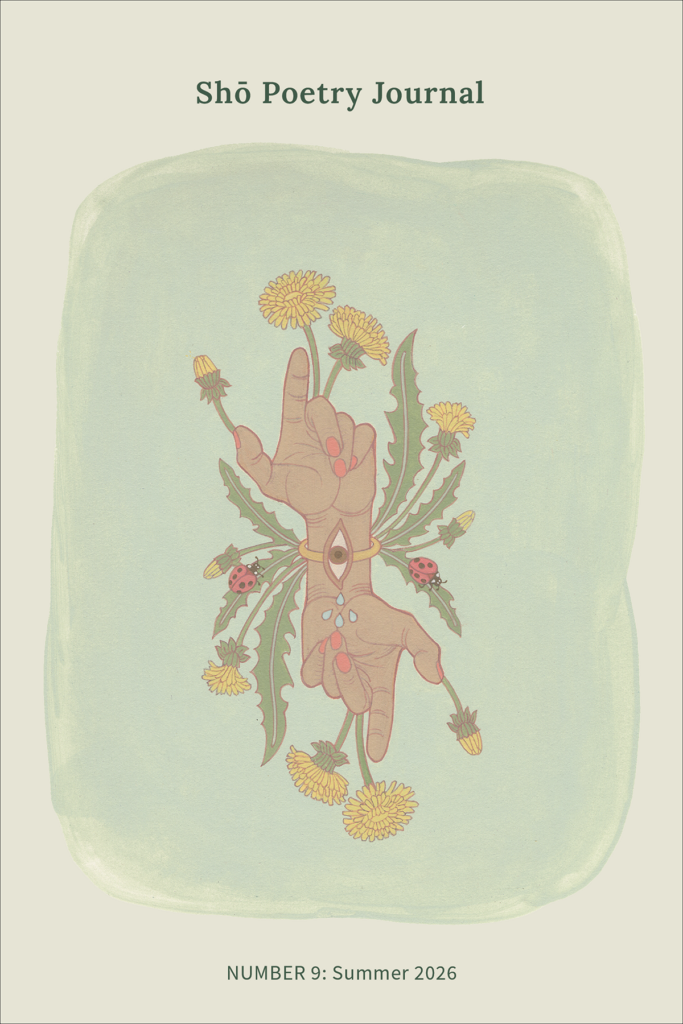
WINNER OF THE SHŌ POETRY PRIZE: REBECCA HART OLANDER
An Old Story
We’ve all been in the dark, accompanied,
the breath of something unwanted
too close. So close it feels like fire.

There was a shed I went in as a child.
A man was there, a neighborhood man.
There was a closed door. A darkness.
That’s all there is, and yet it’s there.

I’d rather be writing about yard jays.
I try to bring them in. To conjure spring.
The fragile shells. The woven homes
of hair and newspaper. The thrift.

But there’s also theft.
And squawking. Their aggressive
insistence on more space.

In the shed, there were tools.
A coil of hose. Old, dirty things.
I couldn’t make them out, exactly.

I like bluebirds better than jays.
They remind me of first seeing cornflowers
by the highway. I didn’t know flowers
could grow like that. Not the proximity

to concrete, but the rare shade.
Hydrangea. Veronica. Grape hyacinth.
Delphinium. Forget-me-nots. Salvia.
Like the sky without clouds. Unfettered.

How old was I when that wooden door closed
out the sky? I wrote a whole book about
my childhood, and only now do I remember
that 8 x 8 room behind a house we rented.

The breath has surely stopped
in whoever that was, considering
I’m beyond the middle of my own life now.

Turpentine, I think it smelled like,
flammable, and a certain kind
of fertilizer, meant not only to keep,
but to control a growing thing.
AUDIO
About this Poem: This poem is kind of mysterious to me—an unearthed memory that leapt onto the page when I wasn’t expecting it. It started in a mini writing marathon held by Joan Kwon Glass on New Year’s Day, 2026. One of the poems we read for inspiration was Laura Apol’s “Regret,” published in The Shore. That piece contains, among other things, a woodshed, some blue, and some orioles, and it closes with the idea of surprise, which was one jumping-off point for the prompt. I ended up surprising myself by recalling, though writing, a shed from my past, and, for me, blue jays flew in (an echo of the orioles, and the blue). As I worked on my poem, the birds became a way to enact how trauma insists on resurfacing, despite years, or miles. How you can try to think about something else—DO think about something else for decades—but it pokes back in anyway, insistent, weighty, lasting, even if limited.
This poem was selected as the winner of the Shō Poetry Prize for Shō No. 9.
Read about the Shō Poetry Prize here, or view past recipients and honorees.
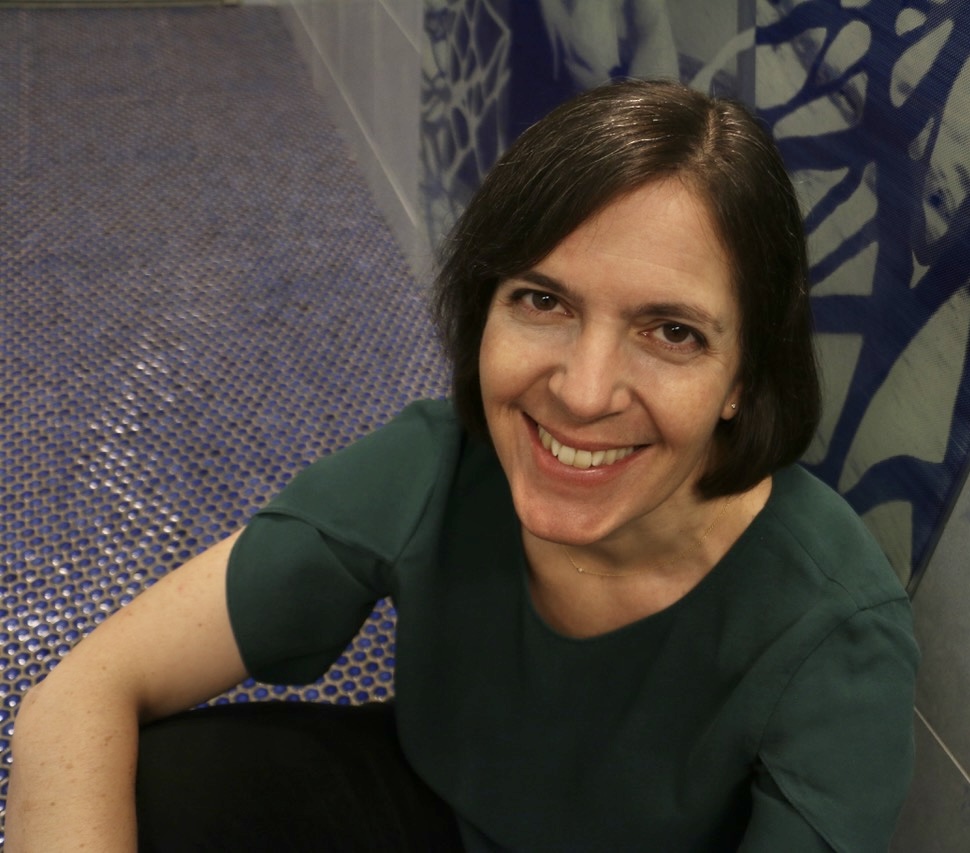
Rebecca Hart Olander’s poetry has appeared recently in MER, On the Seawall, and Poetry Northwest, and her collaborative visual and written work has been published in multiple journals and in They Said: A Multi-Genre Anthology of Contemporary Collaborative Writing, from Black Lawrence Press. A Women’s National Book Association Poetry Award winner, Rebecca’s books include Dressing the Wounds (a dancing girl press chapbook, 2019), Uncertain Acrobats (CavanKerry Press, 2021), a finalist for the Eric Hoffer Book Award and longlisted for the Massachusetts Book Award, and Singing from the Deep End (CavanKerry Press, 2026). Her work has been supported by Straw Dog Writers Guild and the Mass Cultural Council. Rebecca has taught writing widely, most recently as the James Merrill Visiting Poet at Amherst College, and she works with graduate student poets at Wilkes University. She is the editor/director of Perugia Press, an independent feminist press publishing emerging women poets.